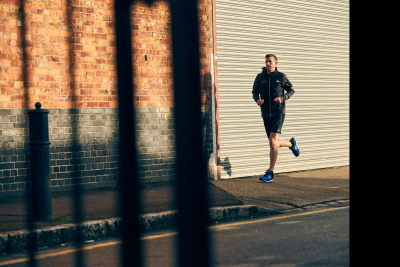
Runners come in all different shapes and sizes so it is difficult to say what is the best running form. Just like training plans, it is illogical that one particular style will suit all runners, however below are some tips to help improve your form.
Posture
The same posture that’s good in your everyday life is good for your running. Focus on running tall with relaxed shoulders to encourage a non-slouching posture, which is best for running. Think head above shoulders, shoulders above hips, hips above knees and ankles. Modern life encourages us to slouch so fight that in running and run tall.
Arm swing
When running, your arms should be bent at roughly 90 degrees. Your hands should be lightly clasped (as if holding an egg) and when your arm swings, your hands should brush between your lowest rib and your waist. The swinging action itself is front to back and relaxed. Any abnormal swinging (crossing the body, elbows wide, shoulders high) will have consequences in your mechanics. I myself am guilty of swinging my arms across my body, especially when I’m tired. I’m also terrible for tensing up when I should be focusing on relaxing. If it helps smile when you’re running, it helps to relax your whole body! Race photos often illuminate any arm swing issues and you can have someone video you while running from the front and back to evaluate your arm action. Imagine there is a box or picture frame from your shoulders to your hips. Your arm swing should be within this box and your hands should not cross the midline of the body. Don’t force it because this will increase tension but be rigid and make sure your arms stay within the box.
Foot plant
There is conflicting advice regarding foot strike, either being a toe runner or flat footed. Instead of focusing too much on where your foot lands think instead about landing underneath your body. Over striding is more of an issue than where you land on your foot. Runners can over stride with a forefoot plant as well as a heel plant. The key is to focus on landing under you and pushing behind you. I find if runners think not about reaching out in front to go faster but instead think about pushing harder down and behind, they cure their over striding. Again, have someone video you from the side while you are running and you’ll see if you are landing far in front of your body (over striding) or nearly under your body (correct landing).
Cadence
A few years ago, researchers suggested a cadence (or stride frequency) of 180 steps per minute was optimal. I would suggest anything from 170-190 works depending on the runner. If you look at most runners, regardless of speed, that look really good, they usually have around this cadence.
You can count your steps in one minute to get your cadence or most GPS monitors now do this for you as well. If you do find you need to increase your cadence, just make sure you aren’t sacrificing stride length by shortening your stride too much. Under striding to achieve an optimal cadence will slow you down. We want an optimal stride rate (cadence) and an optimal stride length. They both go together to create our speed.
Rhythm
The runners who look the best, regardless of speed, are the ones that have great rhythm when they run. Think of the Kenyan athletes and the flow to their stride. They are relaxed and rhythmic. Think of this when you run. We like to say, pop pop pop when we’re running. This simple cue usually cures most form issues and results in a great running rhythm.
Remember everyone is different and there is no one style that will suit all runners. We can all spot training partners from a mile away just by their stride but just think about the points above next time you’re out training.