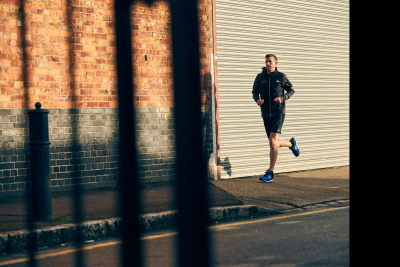
If you’re good at down hills you can use them to your advantage and catch the runner in front of you.
Running downhill is an activity that is nearly impossible to mimic. There are no machines at the gym; no stretches or medical tools that can properly prepare your legs for the rigors of a long trail descent. Unless you’ve programmed some regular downhill running sessions into your training schedule, come race day, you could find yourself relegated to a walk with burnt quads.
Downhill running is an eccentric exercise where the muscle is severely stressed during use due to the forces of deceleration (or braking) and impact absorption. Eccentric use of a muscle can cause it to work beyond its full potential. An example of this is moving a heavy object—it’s much easier to put down a heavy item (running downhill) than it is to pick it up (running uphill). This excess stress causes significant muscle damage.
If you are not physically prepared for descents on race day, the effect will be twofold. First, damaged muscle fibers caused by early downhill miles in the race will negatively affect the latter portion of your race. Your legs will feel heavy and tired well before you reach the finish line. Damaged muscles don’t perform as efficiently as healthy muscles. In the hours, days, and perhaps weeks after the competition, you will experience delayed onset muscle soreness (DOMS), which will impact your post-race recovery and return to normal training. Those who’ve ran the Great North Run will know all about this!!
I am not a fan of running specific downhill sessions. Overzealously training your downhill muscles or racing aggressively without proper preparation will prohibit you from being able to train comfortably for a week or more and, possibly, cause injury. Instead adding hill circuits into your schedule cannot only help you gain confidence in your downhill ability, but you’ll improve your sense of balance and leg turnover.
Next time you run a hill session consider jogging the downhill recoveries rather than walking. Over time you can increase the speed of your descent, which is a win-win as it also shortens your recovery! At UTS Run Club for example we have two sessions that are great for improving downhill running – the Hill Combo Run and the Greenbank Hill Circuit. For those who’ve not done a hill session at the club the hlll combo run is exactly what it says on the tin – a hilly run combing a selection (12) hills. We either run the loop as a hard effort, which means running the down hills fast or jog them as our recoveries focusing on really working the up hills. Think of a game of snakes and ladders and going up and down the roads – this is basically the Greenbank Hill Circuit consisting of 8-hills, which is also great for both up and down hill running.
If you are conscious of improving your strength for downhill running, then it could be wise to invest some time in the gym. Down hill running produces a lot of torsional forces on the legs, knees and hips. These forces can cause over pronation, discrepancies in leg angles and impactive forces that stress everything from the pelvis on down, and can cause Iliotibial Band Syndrome.
Downhill running can lead to postural changes that can stress the lower back and some of the glute muscles. Generally, weak core muscles are the culprit.
Due to the cumulative stress and continuous pounding placed on the lower extremities, downhill running can eventually cause ankle or shin pain for the runner. Make sure you spend time strengthening and mobilisng your lower legs and feet.